Sunday, July 18, 2010
Turkey Hungry For First Women's Medal in Basketball

Sunday, July 11, 2010
Muslim women game for rugby
By FINBARR BUNTINGNEW Zealand's traditional game has a fledgling following in a very unlikely place.
Following male-dominated Iran's relaxation of social rules in the 1990s, women began playing rugby union.
Auckland-based, Iranian-born, film-maker Faramarz Beheshti, 51, was so fascinated he made a documentary about it.
Salam Rugby will feature at the 2010 New Zealand International Film Festival, which screens until July 25 in Auckland.
"I went to Iran in 2006 to work on another film project that didn't end up happening and I saw by chance a picture of these girls playing rugby," Beheshti told Sunday News.
"I found it kind of charming as an idea so decided to work on it."
Beheshti said the code became so popular that representatives from around Iran gathered for training.
But soon after the birth of the new women's sport, legislation was introduced limiting the amount of contact men could have with women. That made it difficult for a male coach to take part in training.
The film, Salam Rugby, follows the would-be players as they challenge the law so they can compete.
"Sport is one of the few avenues for women in small towns to get out of the house," Beheshti said. "But the available rugby trainers were all men. The past four or five years have severely restricted the development of the women's game.
"The sport has potential in Iran for men, but with women there is a dire need for female coaches."
Beheshti is married to a Kiwi and has lived in New Zealand with their children since 2005, where he gained a passion for the game.
"Growing up in Italy it was all about football."
Beheshti was born in Iran and emigrated to Italy when he was four so had little experience of his birthplace before he made Salam Rugby.
"It gave me the opportunity to meet these wonderful people in this wonderful country. I had a desire to visit Iran properly but I now feel so blessed I have the chance to experience this," he said. And he loves his new homeland. "I love Auckland, I've found my spiritual city. It's beautiful."
Source: http://www.stuff.co.nz/sunday-news/news/3906876/Muslim-women-game-for-rugby
Saturday, July 3, 2010
Muslim women’s cricket at the Lord’s
By Neelam Farzana
Cricket in England is a sport of the elite, in South Asia, it is the sport of the people. Followed with a ferocious passion by so many, mums, dads, brothers, sisters, uncles and aunties all gather round staring intently at the TV…but for many women in the Muslim community that’s where it ends.
Many of us have been fans of the great game for a long time but have never been given a real chance to actually play it here in the UK whether that be due to cultural influences or a lack of facilities. So imagine my jubilation when I heard of the opportunity to once again pick up my playing career at none other than the Lord’s, the home of cricket!
Over two Saturdays on May 15 and 22, the Muslim Women’s Sports Foundation (MWSF) in conjunction with the England and Wales Cricket Board (ECB) and Marylebone Cricket Club (MCC) provided the opportunity for women and children of all ages to experience the facilities and atmosphere of the Lord’s Indoor Cricket School.
On entering the grounds the awe and excitement on the faces of those participating shone as brightly as the gloriously white, spaceship like media centre reflecting the sun’s rays. Greeted by England ladies international Isa Guha, and ex-international Laura Newton, the sessions catered perfectly to the needs of the Muslim community enabling women from all backgrounds and abilities to enjoy a fun family day out.
First time participant, Nabeela Akram attended with her two children aged 5 and 7. Commenting on the day she said, “It was a wonderful experience. I am a passionate follower of cricket but with two young children I never get the opportunity to actually play. Playing at Lord’s is an experience I will never forget and my kids absolutely loved it. I hope I get the chance again.”
MWSF Chairperson, Rimla Akhtar, said, “We are grateful to the MCC and ECB for enabling us to bring this event to our community at such a prestigious venue. This is one way of empowering ourselves, our women, and a strong way of providing opportunities to those who are often forgotten in the ethnic minority communities.”
Following on from the success of this event and due to popular demand, the MWSF will be working with the ECB to provide further opportunities for ethnic minority women to access cricket throughout the UK.
Anybody interested in getting involved should contact the MWSF on 020 8427 0873 or email info@mwsf.org.uk
Source: http://www.muslimnews.co.uk/paper/index.php?article=4705
Thursday, June 24, 2010
Afghan women footballers dream of World Cup
By Daphne Benoit (AFP) – KABUL — On a yellowing football pitch, next to concrete walls and razor wire, World Cup fever is running high for Afghan women footballers who dream of scoring for their war-torn country.
Training sessions may be interrupted by US helicopters landing, but the women play hard, tackling each other to the ground under the scorching summer sun.
"If anybody does that to me again, I'll do it to her," shouts one of the players after coming down in a tackle.
"Why are you laughing?" yells another at her teammates. "We have to be serious and exercise seriously."
Afghanistan is not likely to compete in a World Cup any time soon but its women's side trains fiercely in the heat, wearing headscarfs, track suits and long sleeves that cover everything except hands and faces.
Wearing shorts in Afghanistan is taboo. A few of the more daring players have swapped Muslim veils for baseball caps as they train next to the NATO headquarters in Kabul, nerve centre of a nine-year fight against the Taliban.
With the World Cup under way in South Africa, Hadisa Wali isn't missing a second of the action. She predicts victory for Brazil but her football hero is Cristiano Ronaldo, Real Madrid's star Portuguese midfielder.
Her favourite female players are Brazil's Marta Vieria da Silva and Germany's Birgit Prinz, two stars of international women's football.
Teammate Khalida Popal calls football "a passion" but a struggle for women, who were forbidden from sport and all public activities, including going to school, under the 1996-2001 Taliban regime.
"It's hard to play football here," she explains. Aged 20, she is one of the oldest players in a young Afghan team. She watches recruits shooting at the goal, clad in T-shirts bearing the image of President Hamid Karzai.
"Some families refuse, they say this is not for girls," she says. "Others don't like it that we go abroad without our families."
In 2007, the women's team started to travel, playing in Germany, Jordan and Pakistan.
"Sometimes, it just makes me cry. You have to fight to continue to play. It's just like the Americans who fight against the Taliban," she says.
Under the post-Taliban Afghan constitution, women are equal to men and a handful have competed in overseas competitions, mostly in martial arts events.
But women's groups say they remain the most marginalised and underprivileged group in the country, subject to violence and discrimination in the name of Afghan tradition. The war is another hindrance.
In the middle of training, the team suddenly races for the stands as -- without warning -- two US helicopters prepare to land on the pitch."Normally they warn us, but this time they've forgotten," says Wali, bending over to protect herself from the powerful downdraft as a Black Hawk has just set down on the grass.
Due to safety concerns in Kabul, where Taliban suicide attacks are on the rise and where facilities are few, women play on ground attached to the general headquarters of the 142,000-strong foreign military in Afghanistan.
When the aircraft take off, training can resume. In red jerseys and football boots, the teenagers run drills under the watchful eye of their trainer, the only man to be seen.
Kawsaz Amine, 16, came to watch. She feels sick so is not playing, listening to pop star Shakira's World Cup hit on her mobile phone.
Like her sister, who also plays in the national team, she was brought up with a passion for "The Beautiful Game".
"My father was footballer, my uncle too. They are very happy that I play in national team," Amine says.
For her, Argentina are well placed to win the World Cup. Her favourite player and inspiration is Argentine star striker Lionel Messi.
"I want to become the Messi of Afghanistan," she says with a huge smile.
Source: http://www.google.com/hostednews/afp/article/ALeqM5gnZxctlhQh8HQCmsyeJblwv3Njlg
Saturday, June 19, 2010
Palestinian women take over the raceway

Washington – Female racers are becoming more common on Palestinian race tracks as motorsports grows in popularity, Ma’an News Agency reported Monday.
As the Palestine Motorsports Federation and British Consulate General finished two days of training for women racers in Ramallah, a number of new faces got behind the wheel. Nine women took part in the weekend workshop, preparing for a race against their male counterparts in two weeks. The workshop, hosted by British racer Helen Elstrop, aimed to improve the women’s racing skills and technique.
One woman who took part in the workshop, 30-year-old Hamameh Jorban, had previously only been a fan of the sport, supporting her favorite racers from the sidelines. "Now, I will compete with all," she said. Another racer, Samia Khoury, is a mother of two from Jerusalem and said her husband, a racing trainer himself, had "encouraged me to race many times, but now, I feel able to compete with other women on the track."
The women at the workshop were trained on league regulations, professional racing, and techniques to become a high-scoring racer. Palestinian champion racer George Sa’adeh, the only male in attendance and brother of one of the woman racers, also helped Elstrop with the training. The workshop is “an excellent move” said George. He also lauded Elstrop for her efforts, saying, "Helen was wonderful, and she's been a coach and a racer for 17 years, and is married to a racer!"
Motorsports in Palestine have been a growing sport for several years, with the first league race held in Jericho in 2005, according to the Palestinian Motorsports Federation. Racers and their fans often come from across the territories to represent their home districts in the races, and in 2008 Palestinian racers traveled to Jordan and Egypt for competitions.
Though the league is few years old, women have only more recently joined the sport. Jospeh Handal is one of the federation’s founding racers and envisions the sport as an opportunity for all Palestinians, regardless of their gender. Betty Sa'adeh, George's sister, raced for this first time in August 2009, and she has not stopped since. "I encourage all the girls to join the race because it is so much fun," she said.
One of the barriers that both men and women racers alike must face is the rising cost of the sport. The Sa'adeh siblings both spoke in an interview about the burdening costs, saying competition gets steeper as the need for modifications to their racing vehicles increase. The cost for these improvements comes from their own pocket unless they find a sponsor.
To cover their costs for now, Karen McLuskie, who heads the British racing project, said the women’s team would have a separate budget for racing maintenance. McLuskie also spoke of the importance of Palestinian independence and of racing as a means to improve the image of Palestinian women.
“We encourage the establishment of a Palestinian state, and it needs to have a good image, a better understanding and view of Palestine, and especially of Palestinian women," McLuskie said. "When I came to Palestine and saw women racing, I thought it was a great project and sport to encourage that gives women a chance to express themselves and prove they are not ignored or marginalized.”
Source: http://palestinenote.com/cs/blogs/news/archive/2010/06/15/palestinian-women-join-the-race.aspx
Friday, May 28, 2010
Leader of Afghan women’s sport: Playing is political

By Sarah Odell and Lindsay Rico
Nasrin Arbabzadeh, the leader of the Afghan women’s sports delegation, has been actively working for years for the rights of Afghan women to complete in sports. In 2001, she traveled from city to city recruiting women to compete in the the Third Muslim Women Games. At the time, she told theMinneapolis Star-Tribune that she wore a burqa so as not to draw attention to her work. “My life would have been in danger if the Taliban had learned of my activities and my purpose,” she said.
During the opening ceremonies of those games, organizers staged a black out and many athletes wore black mourning clothing and carried candles as a sign of support for the 48 Afghan delegates. Their participation was a symbol of political resistance. “I’m competing here to denounce the Taliban’s uncivilized treatment of women in the name of Islam,” Salma Hosseini, tae kwan do silver medalist, announced at the time.
Last week, at the Fifth World Conference on Women & Sport in Sydney, Ababzadeh stood in a question and answer period, and sought insight into how to develop, support, and train female athletes in Afghanistan. “Does anybody know about the women in Afghanistan?” she asked. The hall was silent.
FGN spoke with Arbabzadeh about her work and the challenges for female athletes in her native country.
FGN: In Afghanistan, what kinds of sports do women compete in?
NA: They play football (Soccer), badminton, basketball, taekwondo, and volleyball. But it’s very hard for them. At first, their families are not happy and they make it difficult for the girls to play. But when these girls bring home medals and awards, then their parents are happy for them.
FGN: What are some of the challenges these girls and women experience?

NA: The difficulties don’t end with the family. Most of our athletes don’t have the right clothes, shoes, or food. And athletes who have become successful are often threatened. Sixty percent of people are happy with them, forty percent are not. People think they are bad girls because they have chosen to participate in athletics.
FGN:What is your role in women’s sports in Afganistan. Who has been important to your work?
NA: I am the first woman to start sports for girls in Afghanistan. I am so happy with Faezah Hashemi, the Iranian president of the Islamic Federation of Women Sport. She has helped lots of young women within the federation, regardless of what country they come from.
FGN: How did you first get girls involved in athletics?
NA: In 2001 I collected young girls who wanted to play sports brought them to the Muslim women games in Iran. The girls competed in volleyball, tae kwan doe, shooting, tennis, running, chess, and badminton. I paid for everything so my teams could go to this competition. The girls and their families were so happy, because in Afghanistan, there are no teams that allow women. But leaders in Afghanistan did not like what I was doing and I received threats, so [after the games] I went back to Iran.
FGN: Who was behind the threats? Why were you threatened?
NA: The Olympic manager. He did not have a lot of experience. He saw that I had experience and knowledge. I saw many things I wanted to change. I saw the disabled athletes had terrible equipment. I wanted to help them. I asked him why they did not have better equipment and he did not like that. He told my husband that if I had any more things to say about the Olympic management or problems, he would kill me.
Arbabzadeh now lives abroad, in Australia, and serves on the Women with Special Needs Committee for the Islamic Federation of Women Sport.
Wednesday, May 26, 2010
New Book On Shelves: "Muslim Women and Sport"
Edited by Tansin Benn, Gertrud Pfister, Haifaa Jawad.
- Binding/Format: Hardback
- ISBN: 978-0-415-49076-4
- Publish Date: July 9th 2010
- Imprint: Routledge
- Pages: 304 pages
Examining the global experiences, challenges and achievements of Muslim women participating in physical activities and sport, this important new study makes a profound contribution to our understanding of both contemporary Islam and the complexity and diversity of women’s lives in the modern world.
The book presents an overview of current research into constructs of gender, the role of religion and the importance of situation, and looks closely at what Islam has to say about women’s participation in sport and what Muslim women have to say about their participation in sport. It highlights the challenges and opportunities for women in sport in both Muslim and non-Muslim countries, utilising a series of extensive case-studies in various countries which invite the readers to conduct cross-cultural comparisons. Material on Iraq, Palestine and Bosnia and Herzegovina provides rare insights into the impact of war on sporting activities for women. The book also seeks to make important recommendations for improving access to sport for girls and women from Muslim communities.
Muslim Women and Sport confronts many deeply held stereotypes and crosses those commonly quoted boundaries between ‘Islam and the West’ and between ‘East and West’. It makes fascinating reading for anyone with an interest in the interrelationships between sport, religion, gender, culture and policy.
Contents:
Introduction - Muslim Women and Sport Part 1: Underlying Contexts 1. The Values of Physical Activity, Sport and Physical Education in the Lives of Young Women 2. Islam, Women and Sport 3. Muslim Women and Sport in Diasporas: Theories, Discourses and Practices - Analyzing the Case of Denmark Part 2: National Perspectives 4. Women in Sports Leadership in Bahrain 5. "Balancing between the cultures …" – Sports and Physical Activities of Muslim Girls and Women in Germany 6. Physical Activities and Sport for Women in Iran 7. The Sultanate of Oman and the Position of Girls and Women in Physical 8. Women and Sport in Syria 9. Struggling for Empowerment - Sport Participation of Women and Girls in Turkey Part Three: Case Studies 10. Palestinian Women’s National Football Team Aims High – Case Study to Explore the Interaction of Religion, Culture, Politics and Sports 11. Challenges Facing South African Muslim Secondary School Girls’ Participation in Physical Activities, Physical Education and Sport. 12. Religion and the State – The Story of a Turkish Elite Athlete 13. A Case Study on United Arab Emirates: Women, Disability and Sport Part Four: Narratives 14. Experiences of War in Bosnia and Herzegovina and the Effects on Physical Activities of Girls and Women 15. Women in Sport in North Africa: Voices of Moroccan Athletes 16. Womens’ Narratives of Sport and War in Iraq Conclusion
Monday, May 24, 2010
Turkey’s female cirit players on hunt for competition


Sunday, May 9, 2010
Women race in rare track meet in Hamas-ruled Gaza
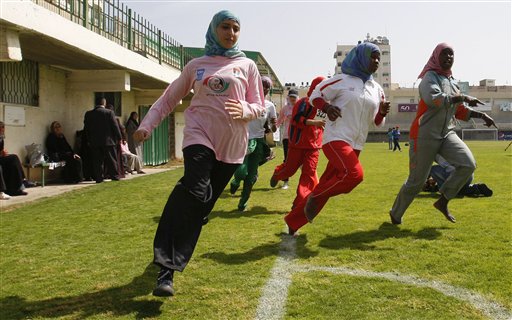
About 40 women in tracksuits and headscarves have competed in a rare track meet in Hamas-ruled Gaza. The athletes ran 100, 400 and 1,500 meters in Saturday's championship. Some raced barefoot and others waved to cheering spectators during their races. Runner Ghada al-Zamt came third in the 1,500 meters. She says women's athletics are not encouraged in Gaza. Participants in Saturday's meet included university students and amateur athletes. Gaza's Muslim rulers — and most residents — disapprove of women's sports because it can reveal their body shape. It is also difficult for athletes to compete internationally because Gaza's borders have been virtually sealed by Israel and Egypt since the Hamas takeover in 2007.
Palestinian girls take part in a race during a track meet for Gazan women at the Palestine Stadium in Gaza City, Saturday, May 8, 2010. The sporting event was co-sponsored by the Palestinian Olympic Committee and the UN in order to encourage Gazan women to do more sports. (AP Photo/Hatem Moussa)
Palestinian girls cheer for women athletes, not seen, during a track meet at Palestine Stadium in Gaza City, Saturday, May 8, 2010. The sporting event was co-sponsored by the Palestinian Olympic Committee and the UN in order to encourage Gazan women to do more sports. (AP Photo/Hatem Moussa)

A Palestinian girl takes part in the long jump during a track meet at Palestine Stadium in Gaza City, Saturday, May 8, 2010. The sporting event was co-sponsored by the Palestinian Olympic Committee and the UN in order to encourage Gazan women to do more sports. (AP Photo/Hatem Moussa)
Source: The Associated Press
Muslim Women are Taking Part in Aqua-aerobic and Swimming Events
All these year’s Muslim females have faced the problem of finding an appropriate swimwear which adheres to the Koran, which requires a woman to cover everything except her face, hands and feet.
The swimwears available in the market were either not targeted for the Muslim women as they led to show of skin or were unpractical for swimming. To aptly describe how uncomfortable the swimwear designed for Muslimahs was I shall quote Aheda Zanetti who wrote to the National Geographic News stating “As an active Muslim girl, I found it difficult to participate in most sports, because of all the excess clothes we were wearing. And the veil very unpractical when playing sports”.
For a market that was not targeted by big market share holders like Nike scattering small companies took the initiative of designing something fruitful for Muslimahs. People like Zanetti, Oliver Momeni and Hasema saw a great potential and design need in the market of swimwear for Muslimahs. Zanetti, is the owner of Ahiida, an Australian company that designs women’s sportswear. Oliver Momeni started his venture of Bodykini in 2007, based in Spain and Hasema a Turkish company started designing a line of swimwear for men, women and kids. Among all these products the most admired and reviewed is “Bodykini”.
Surely, Oliver had the support and opinions of his Iranian family members and an experience of over 20 years in the family textile business. Before designing the final product “Bodykini”, Oliver conducted a lot of market research and held talks with many Muslim women. In the course of his time, he learned the important attributes targeted while designing the swimsuit. He designed Bodykini which is a complete blend of a swimsuit that looks great, designed for modest comfort, adheres to Islam’s tradition and most importantly lets women swim without any fear.
It does so by removing all the excess fabric that the previous swimwear provided like the veil, pants and skirts. Oliver incorporated every thing into 2 main piece of clothing: a shirt with a hijood that serves as a close-fitting headpiece, which firmly lays on the head without slipping and a pant. The fabric used is a high quality water-repellent fabric that is not only highly Chlorine resistant but also provides protection from ultraviolet rays. The advantage of using a Polyester material is that it has low water absorbency, dries fast and ensures complete stretch in all directions leading to comfortable swimming or aqua-sport.
The Bodykini comes in two colors to choose from and two unique features. The first feature is the two elastic bands that are attached at the inside of the pants that get buttoned to the inside of the suit, which prevent the suit from floating in case the swimmer performs a feet first dive. The second feature is the small pocket with a zipper in the pants; ideal for keeping small items like keys or money.
So now, with products like Bodykini both the problems namely: meeting the Islamic traditional requirements and availability of a comfortable swimming garment for women, are solved. Bodykini is available online at bodykini. com. Along with this Bodykini has been launched in the Middle East and is available in Dubai at Al Boom Marine retail stores or at the Dubai Ladies Club.
Now, Islamic women can remain more active and enjoy the aqua sports with the power of Bodykini. The Bodykini modest swimwear is becoming popular among not just the Muslim population but also among all those women who love to cover their bodies and prevent the tans while enjoying the relaxing water.
Having said all this, Oliver Momeni is not just being thanked by all Muslim women for introducing such a wonderful product in the market but the big players are looking forward to promote products like Bodykini which is showing a very good grip on the swimwear market. Taylor, of Azizah Magazine, says that
“In another 15 years there’s going to be a sizable Muslim consumer market and lots of demand”.
I think we’re where the Hispanic market was 20 years ago, and today the Hispanic market is a big consumer market. ” Further more, Arun Jain, a marketing professor at the University of Buffalo in New York State, agrees and states that given the growth potential of the Muslim community in the United States, major sportswear manufacturers could be missing out on an opportunity to break into an emerging market. Moreover, more than just the Muslim women the modern world women comprising of Christian, Jews and others don’t feel the need to show off their bodies and strive to be modest.