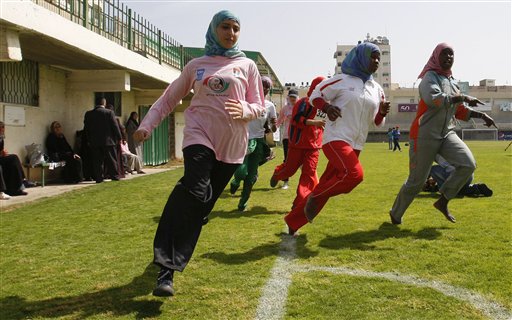
They only recently got a grass practice field. They've come under attack on their Facebook page, and some fear telling their relatives that during their spare time they play soccer.
Such are the troubles for the national women's team from the United Arab Emirates. And this is progress.
Recently, the UAE women scored their greatest triumph, making their first appearance in a major tournament. Playing live on national television - and in front of a boisterous crowd of several hundred men - the Gulf upstarts stunned reigning champion Jordan 1-0 in the West Asian Football Federation championship.
"It has made me so proud," said Alaa Ahmed, a 15-year-old midfielder who is one of the few players wearing a tightly drawn, black head scarf, leggings and long-sleeved shirt during matches. "Afterward, the other kids in school came up and asked for my autograph. They said I was a star. It's a great feeling."
The topsy-turvy journey of the UAE team is emblematic of the issues faced by female athletes across the Islamic world.
 Helped by families moving to the cities, better education and increased government support, Muslim women from Indonesia to Morocco are taking up sports in small but growing numbers. They are forming soccer leagues in Turkey, boxing clubs in Afghanistan and rugby teams in Iran. Nearly 150 female athletes from 18 Muslim countries took part in the 2008 Beijing Games, a record and a fivefold increase from the 1988 Seoul Games, according to the International Olympic Committee.
Yet the growth comes in fits and starts, and is vulnerable to age-old cultural pressures, modern rules and varying player commitment.
Saudi Arabia, for instance, does not allow women to participate in the Olympics and the once-banned Kuwaiti soccer team was denounced on its return from the WAFF tournament by conservative lawmakers who want a ban on all international competitions. In Iraq, a women's wrestling club disbanded last year after receiving death threats from religious groups.
Then there is growing debate on the wearing of head scarves at sporting events. While rugby, volleyball and taekwondo federations allow them, FIFA has resisted lifting a ban - standing by rules designed for safety but seen by Muslims as discriminatory.
Last month, FIFA initially blocked the Iranian girls' soccer team from competing in this summer's inaugural Youth Olympics over their insistence on wearing head scarves - which some Muslims say protects the modesty of Islamic girls and women. FIFA allowed them back in this month after the team agreed to wear a cap that covers their hair.
"Despite the growth in participation rates, the biggest challenges remain legal prohibitions, social stigma and limited opportunity," said Meghan O. Mahoney, an expert on women's sports at Northeastern University's Sport in Society.
Formed in 2004 by a handful of young women in love with the game, the UAE team operated in name only for the first several years. Then in 2008, the group hired Australian Connie Selby, who instituted regular practices and games with opponents from other parts of the country and tours of Europe.
Their victory over Jordan in February raised the team's profile and turned many of the players into local celebrities.
But on a balmy night at the team's new practice field, a gift of the government located in the shadow of a men's soccer stadium, the limit of their newfound success was easy to see.
Selby, a 50-year-old former Australian national team captain, was running out of patience. She had spent the day gearing up for the intense passing drills and scrimmage. By the time practice was set to start, only Ahmed and another player had bothered to show up. Practice had to be scrapped.
"I've been getting text messages all day from players saying they can't come, they can't come," said a frustrated Selby, who before taking the UAE job coached in Australia and headed women's soccer in the Oceanian Football Confederation.
Retaining players - all of whom are in school or have day jobs as police officers, bankers and administrators - is a huge challenge. Compared to thousands of players to choose from in nations such as Australia or Japan, the UAE only has a pool of 20 who are trying to balance family and work demands with the team.
There is no UAE league to motivate them and games are rare. The next match is another regional tournament in August. Without a league, the team cannot qualify to play in Asian Football Confederation tournaments which could lead to a World Cup berth - a dream of Selby and many of the players.
"A lot of them see this as a job, rather than a love of the game," said Nadine Schtakleff, a 25-year-old banker whose family hails from Lebanon, and who looks a little like America's Mia Hamm with her ponytail and broad smile. She was typical of most of the players, who prefer T-shirt and shorts over the head scarf and long sweats.
"It takes a lot to be committed," she said. "It is new here and there are not a lot of people willing to step out and invest in the team."
And there is the conservative culture to confront. While Sheik Mohammed bin Rashid Al Maktoum, the ruler of Dubai, and his wife, Princess Haya, have championed women's sports and two of Mohammed's daughters took part in the 2008 Beijing Olympics, many Emiratis have their suspicions about Western sports.
They fear that women's soccer forces their women to wear revealing uniforms that will expose their bodies, a taboo in a country of 4.8 million people where the preferred dress is the black, cloak-like abaya and hijab.
As a result, the team has lost several players, including one who left after a relative saw her playing in the championship game without her headscarf.
The job of changing the Emirati mindset falls to Nada Yousef al-Hashimi, a vivacious Ministry of Economy official who took up swimming and track in school. When she is not trying to lure foreign investment into the country, al-Hashimi can be found at the team's practice watching protectively over the players she fondly calls "diamonds" and "stars."
Al-Hashimi insists she is not trying to change the culture as much as making the case that soccer is no threat to local traditions. She tirelessly promotes the team and has been known to engage critics who pop up on the team's Facebook page, which includes a lively discussion page debating the merits of women's soccer in the Middle East, dozens of team photos and links to YouTube videos. A few angry comments criticizing women's soccer as culturally inappropriate have been deleted, though most are respectful, said one of the page's creators, Abdul Razaq al-Kabi.
"We have to respect their ideas and we can do a lot to convince them by showing how the girls play, how they are part of a bigger community," al-Hashimi said.
The UAE players also have to contend with siblings and parents who feel soccer undermines family traditions dictating that a woman's place is in the home. Several spoke of long fights just to play, including one player who no longer talks to her father and a second forced to quit the team for a month after her parents were inundated by complaints from friends and relatives.
"I just told them I cannot survive without playing football," said Nayla Ibrahim, a 25-year-old police officer who is one of the team's goalkeepers. "I was so depressed that I didn't even want to go to work."
Ibrahim's parents reneged and let her return. But they did not attend the championship game for fear they would be seen overly supporting her.
"From the bottom of their hearts," Ibrahim said, "I know they wanted to come and watch me."